Reading the aurora forecast in Yellowknife
Most aurora forecasts lead with the Kp index, a single number that many visitors read like a promise. In Yellowknife that number matters less than you might expect, and the sky overhead matters more. This guide explains what the forecast can and cannot tell you, and how the tours use it on the night.
What the Kp index measures
The Kp index is a scale from 0 to 9 that describes how disturbed the Earth's magnetic field is across the whole planet. A high number means the solar wind is shaking the field hard, which pushes the aurora toward lower latitudes.
That is why the index makes headlines when it climbs high, since people much farther south may then see the lights. For a town far to the north, the same scale reads quite differently.
Why Yellowknife does well on quiet nights
Yellowknife sits on the north shore of Great Slave Lake, roughly 400 km (250 miles) south of the Arctic Circle. It lies under the auroral oval, the ring around the magnetic pole where the lights are most often overhead.
Because the oval already passes above the town, a Kp as low as 1 or 2 can often bring a visible green band. A higher number may bring a brighter, wider display, but a low one is no reason to cancel. No Kp guarantees the aurora, though.
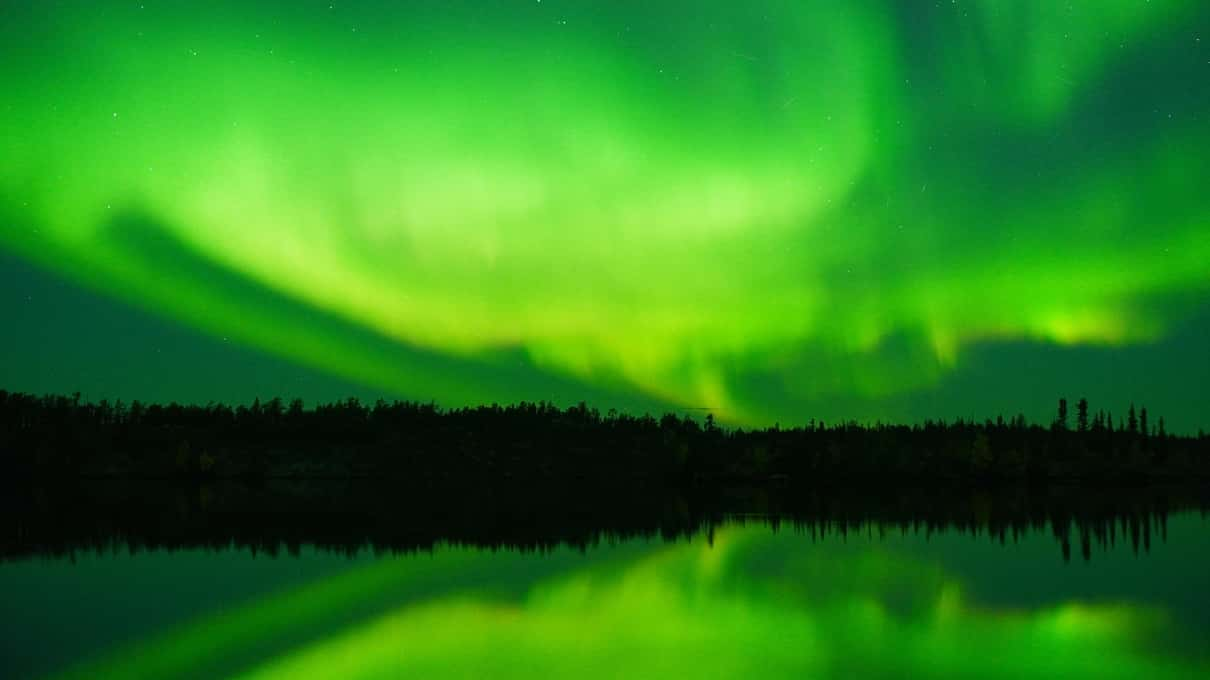
Green is the color you will see most, from charged particles striking the upper atmosphere. On stronger nights pink and red can join it, sometimes with violet. Our guide to photographing the lights explains why a camera picks up these colors better than your eyes.
Clouds decide most nights
The lights form high in the upper atmosphere, so any solid layer of cloud below them hides them completely. Under the oval, cloud cover is the usual reason a night goes dark, far more often than a lack of solar activity.
So the forecast to watch first is the ordinary weather one, the hour-by-hour cloud cover for the evening. Clear skies with a modest Kp usually beat a high Kp under thick overcast. Patchy cloud is the hard case, because a gap can open over one lake while another stays shut.
A rough rule for the afternoon before a tour: check the cloud map first and the Kp second. If the cloud forecast is solid grey all night, that is the moment to think about moving your booking, as our guide to cloudy nights explains.
A forecast that changes by the minute
Aurora forecasts are short-range and uncertain. Predictions a few days out rest on activity seen on the sun, and the solar wind can arrive at a different time or strength than expected. Even the hourly outlook is a broad guess rather than a timetable.
Activity also flares and fades on its own rhythm. A faint arc can sit still for an hour, then break into moving curtains within a few minutes before settling again. Staying out through a quiet spell is often how people catch the best part of the night.
The hours and the moon
The lights can appear any time it is fully dark, but activity in Yellowknife often peaks around 10 pm to 2 am. Treat that window as a habit, not a rule. All four tours we compare run about 4 hours through the middle of the night.
The moon is the other factor. A full moon washes out faint aurora, so a weak display can vanish into a pale sky. It also lights the snow and the trees, which gives photos a visible landscape instead of a black foreground.
New moon weeks give the darkest skies for faint displays. Our guide to the best months in Yellowknife covers the seasons, and the moon is one more thing to weigh when you pick your dates.
How each tour uses the forecast
The tours differ most in what they do when the cloud forecast is mixed. Aurora Bus Tours, from ~$69, has no fixed site at all. Its guide follows real-time conditions and drives toward the clearest sky of the night, and the Viator listing gives a 9:00 pm start.
Destination NWT, from ~$98, splits the difference. On cold, clear nights you spend more time at its warm lodge near Madeline Lake, and when clouds roam the group spends more time on the road looking for a clearer spot.
The cabin tour, from ~$101, stays put. Staff check the sky every few minutes from a heated cabin about 15 minutes from town, so a cloud bank over it means a warm night without the show. Yellowknife Vacations, from ~$62, stops at three locations along the Ingraham Trail.
When the cloud map looks patchy
Aurora Bus Tours treats every night as a hunt, from ~$69 with hotel pickup and professional photos. It scores 5.0 from 60+ reviews on Viator and 5.0 from 20+ on GetYourGuide. Both sites offer free cancellation up to 24 hours ahead.
Planning nights around the forecast
Since the cloud outlook is only firm a day or so ahead, a single fixed night is a gamble. Many visitors plan three or four nights so that one clear sky is likely, and our guide on how many nights to book works through that choice.
Free cancellation helps here. GetYourGuide allows it up to 24 hours ahead on all four tours, and Viator does the same for every tour except the cabin, whose Viator listing is non-refundable. If tomorrow looks fully overcast, you can move the night while the refund still applies.
A chase suits a mixed forecast, while a warm base suits a clear one where you mostly wait. Our comparison of the four tour styles sets out those trade-offs, and what to wear at minus 30 covers the hours you will spend outside watching.